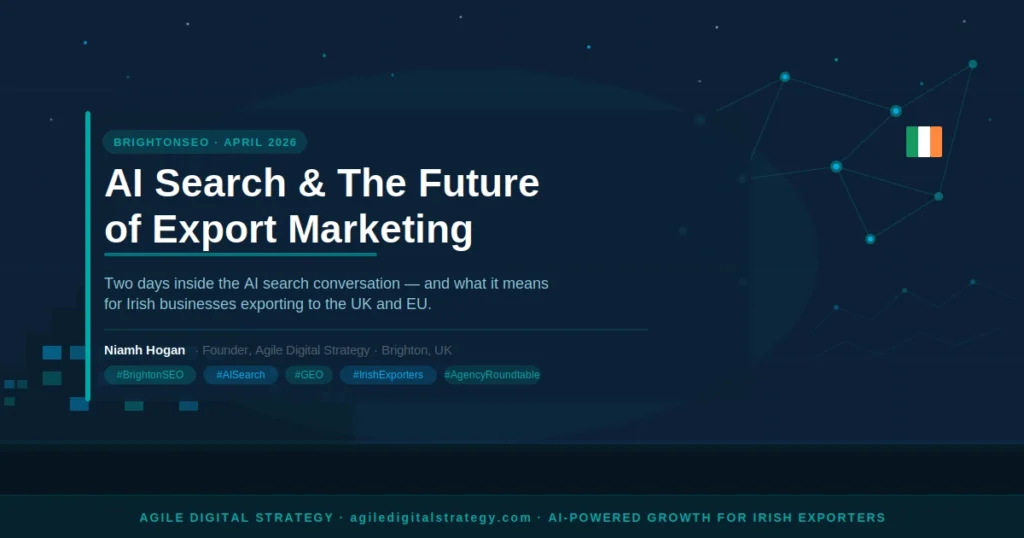
BrightonSEO - Brighton, UK - 30th April–1st May 2026
This is my second BrightonSEO in six months and I have been looking forward to it for a different reason than last October. In October I came to understand the scale of what was changing in search. This time, I am coming to work out exactly what to do about it — in conversations with other agency owners, in sessions with practitioners who are testing things at real scale, and in the kind of corridor discussions that you simply cannot replicate on a webinar.
I am writing this before the conference opens, so what follows is my preview — the sessions I am attending, the agency discussions I will be part of, and the specific questions I am bringing to Brighton from my work with Irish exporters. I will publish a follow-up post next week with what I actually took away.
For now, here is how my two days look — and why each session is directly relevant to the businesses I work with.
Thursday - 30th April 2026 - BrightonSEO
9:30 AM
AGENCY ROUNDTABLE
Meeting with Agency Owners — UK & International BrightonSEO runs a structured gathering for agency owners alongside the main conference — a closed-room discussion with people running businesses similar to mine across the UK and internationally. This is the session I am most personally invested in, and I want to share what is on the agenda. |
Three themes were submitted by agency owners ahead of this session and pulled together as the core discussion topics. They are questions I sit with every week, and I am genuinely curious to hear how others are navigating them:
1
Winning high-quality leads in a noisy, AI-flooded market
Every agency is feeling this. The volume of AI-generated content has made it harder to stand out, and clients are more sceptical about marketing claims than ever. What is actually working for new client acquisition in 2026? This is a conversation I am having with my own business as much as with clients — and I am looking forward to hearing what is working for agencies across different markets.
2
Scaling your agency: Hiring, upskilling and leadership in the AI era Which roles are disappearing and which are emerging? How do you hire when AI changes the skill mix every six months? As a small consultancy with a clear position on what I do and do not do, this is fascinating territory. The AI tools in my stack have replaced work that would have required a small team three years ago — and that changes how I think about growth. |
3
How AI is reshaping agency models, margins and delivery
What does AI really change in service delivery, and how do you protect margins when clients expect ‘AI-powered efficiency’ to mean ‘cheaper’? And critically — what must stay human? I have strong views on this. The research phase of the AI Growth Audit is AI-powered. The interpretation, the strategy, and the recommendations are not. I am looking forward to testing that position in the room.
11:20 AM – 12:40 PM
The Future of Search
This is a dedicated block of talks on where search is heading. Given that the entire AI Growth Audit is built on a clear-eyed picture of how search is changing in UK and EU markets, I treat sessions like this as direct product development — they sharpen the frameworks I use with clients.
Within this block, I am particularly focused on Janaina Barreto-Romero’s session on making sense of AI search with imperfect signals. AI search is moving faster than the measurement tools being built around it, and Janaina’s work at Oncrawl on cutting through the noise to find the signals that actually predict business outcomes is exactly the kind of rigour I want to bring back to client reporting. The question she is asking — how do you make smarter decisions when the data is incomplete? — is one I face every week.
I am also keen to hear Cosmin Negrescu from SEOmonitor on whether AI search strategy is being built on the right foundations. He is using real data to challenge the industry’s emerging visibility metrics, and his measurement framework — built around intent convergence rather than individual prompt volume — aligns with how I already think about search for B2B exporters. Your buyers are not searching for your product name. They are searching for their problem. That distinction matters more than ever in AI search.
2:00 – 3:00 PM
AI Tools & Workflows
This block is the most operationally relevant of the conference for me. My work depends on getting the most out of AI tools while being clear-eyed about what they cannot do. I want to understand how other practitioners are structuring their AI workflows — what they are automating, what they are not, and where the quality control sits.
Tom Winter’s session sits in this zone — his argument that AI systems win not by being smarter than humans but by actually following the process humans claim to follow is something that resonates directly with how the AI Growth Audit is built. AI tools cross-reference more sources, verify more claims, and follow the research brief more consistently than any human workflow does. What the AI cannot do is decide what matters and why. That interpretation is the service. This session will help me articulate that distinction more clearly to clients.
3:30 – 4:30 PM
AI & Consumer Behaviour
This block sits at the intersection of search and buyer psychology — how AI-mediated discovery is changing the way people research, evaluate, and decide. For B2B exporters, understanding the buyer journey in a new export market has always been challenging. AI is changing not just where buyers search but what kind of answers they expect to find.
Rick Tousseyn’s session on 5.5 million AI citations is in this zone — his research into why YouTube surfaces so frequently as a cited source in AI-generated answers is a signal I want to understand. For Irish exporters and businesses trying to establish credibility with buyers in the UK or Germany, the question of which content formats get surfaced in AI answers is directly relevant to how I advise on content strategy. If the evidence shows that video content is disproportionately cited, that is a conversation I need to be having with clients.
5 PM – Close
AI and Content Strategy
The final session of Thursday — and a good one to end the day with, because content strategy questions tend to generate the most heated debate in any room of SEO practitioners.
The core tension I expect this block to surface is one I navigate constantly: AI makes it possible to produce content at a scale that was previously impossible. But AI-generated content at scale is also exactly what has made the web noisier, less trustworthy, and harder for buyers to navigate. The businesses that win in AI search are not the ones producing the most content. They are the ones producing the most credible, specific, well-structured content — built around genuine expertise. That principle is straightforward. The execution is not.
The businesses that will be cited by AI search engines are the ones that AI systems have the most reason to trust.
That is not a volume game.
It is an authority and credibility game — and it plays directly to the strengths of businesses with real expertise and real client results.
Friday - 1st May 2026 - BrightonSEO
9:30 AM
Agency Roundtable
AI in Agencies — Friday Roundtable
A second structured agency discussion — this time focused specifically on AI within agency operations. How are agencies actually using AI internally, and how are they managing the client conversation around it? I am curious whether other agency owners are finding the same thing I find: that clients broadly want ‘AI’ but have very little clarity on what that means or what they should be paying for it.
The conversation I am hoping to have — and possibly to continue into the corridor — is about what ‘AI-powered’ actually means in a service context. For me it means faster, deeper, more rigorous market research. It means the AI Growth Audit can be delivered in 10 days because the research phase that would previously have taken up to and possibly over three weeks of manual work is now run in days. But the strategic interpretation, the commercial framing, and the ranked action plan are not AI outputs. They are the reason a client pays a consultancy rather than running a tool subscription.
11:20 AM – 12:40 PM
AI and Brand Authority
This is the block I am most directly applying to my export clients. Brand authority in AI search works differently from brand authority in traditional SEO — the signals that lead an AI system to cite or recommend a business are not just about links and domain authority. They are about the depth, consistency, and credibility of a brand’s digital footprint across multiple sources.
For an Irish manufacturer trying to establish credibility with buyers in a new export market — buyers who have never heard of them, who are being advised by AI-generated summaries before they ever visit a website — this is the fundamental challenge. How do you build the kind of authority that AI systems recognise as trustworthy? That question is baked into the Current Presence Audit workstream of every AI Growth Audit I deliver, and this session will sharpen how I answer it.
2:00 PM – 3:00 PM
Google Ads
Google Ads might seem like familiar territory in a conference dominated by AI search, but Performance Max, AI-generated assets, and smart bidding have changed the landscape significantly in the past 18 months. Lars Maat’s session on conversion tracking strategies beyond basic pixels is the one I have my eye on.
For many businesses, especially B2B exporters, conversion tracking in Google Ads is deceptively complex. A buyer from a manufacturing firm in the East Midlands does not fill in a contact form at the end of a 30-minute browse. They might visit three times across two weeks, read two case studies, and then call directly. Tracking that journey accurately — and feeding the right signals into Google’s AI bidding systems — is the difference between a campaign that generates pipeline and one that generates clicks. Lars promises to cover eight strategies, including at least one that most people consistently miss. I want to know what it is.
3:30 PM – 4:30 PM
AI and Brand Citations
This is my final session before I head to the airport. Pablo López’s talk on AI-aware citations — specifically how to create and map brand mentions that appear at the right moment across the funnel — is the most tactically forward-looking session of the two days.
The concept he is exploring — turning both real and synthetic user prompts into brand citations — is at the frontier of where SEO and GEO are converging. For an Irish exporter trying to get their brand mentioned in the AI-generated answers that appear when a UK procurement manager searches for suppliers in their category, this is exactly the kind of strategic edge that the AI Growth Audit is designed to identify and create a roadmap for.
I am leaving Brighton straight from this session. There will be no winding down in the bar. But the conversations started on Thursday and the frameworks picked up across both days will be going straight into client work the following week — which is exactly how it should be.
What October Taught Me — and What I Applied
One thing I am asked regularly is whether attending conferences like this actually makes a practical difference. I want to answer that specifically.
After October’s BrightonSEO, I came home with three things I changed immediately. I restructured the content architecture on two client websites to align with the intent clusters that AI Overviews were pulling from — moving away from isolated product pages toward interconnected topic structures that give AI systems a clearer picture of expertise. I updated the keyword strategy for one UK-facing client campaign to focus less on high-volume head terms, where AI Overviews were already answering the query and suppressing click-through, and more on commercial intent queries where traditional organic results still dominate. And I introduced structured data as a standard component of every AI Growth Audit, having seen at Brighton how significantly schema markup influences AI citation behaviour.
Six months on, two of those clients are showing measurable improvement in both rankings and qualified lead flow. The third is building — organic SEO works on a timeline. But the direction is right, and October is where it came from.
I am expecting Brighton in April to produce a similar list of specific, applicable changes. I will share what they are in a follow-up post next week.
Is AI Search Relevant to Your Business?
If you are selling to buyers in the UK or EU — and your target customers are using search to find and evaluate suppliers — then yes, what is being discussed at BrightonSEO this week is directly relevant to whether those buyers can find you.
The AI Growth Audit is the most practical way I know to answer that question specifically for your business: where you currently stand, who your competitors are, how your buyers are actually searching, and what the 10–15 highest-impact actions are to change your position. It runs in 10 working days and costs €3,500 (price correct as of April 2026).
If you want to understand what AI search means for your export pipeline, get in touch when I am back next week.
Short About Niamh
I’m Niamh Hogan, the founder of Agile Digital Strategy, a specialist B2B growth consultancy for Irish businesses & exporters based in Newmarket on Fergus, Co. Clare. I was listed as one of Ireland’s Top 100 Inspiring Women Entrepreneurs.