Quick Answer – Google AI Overviews |
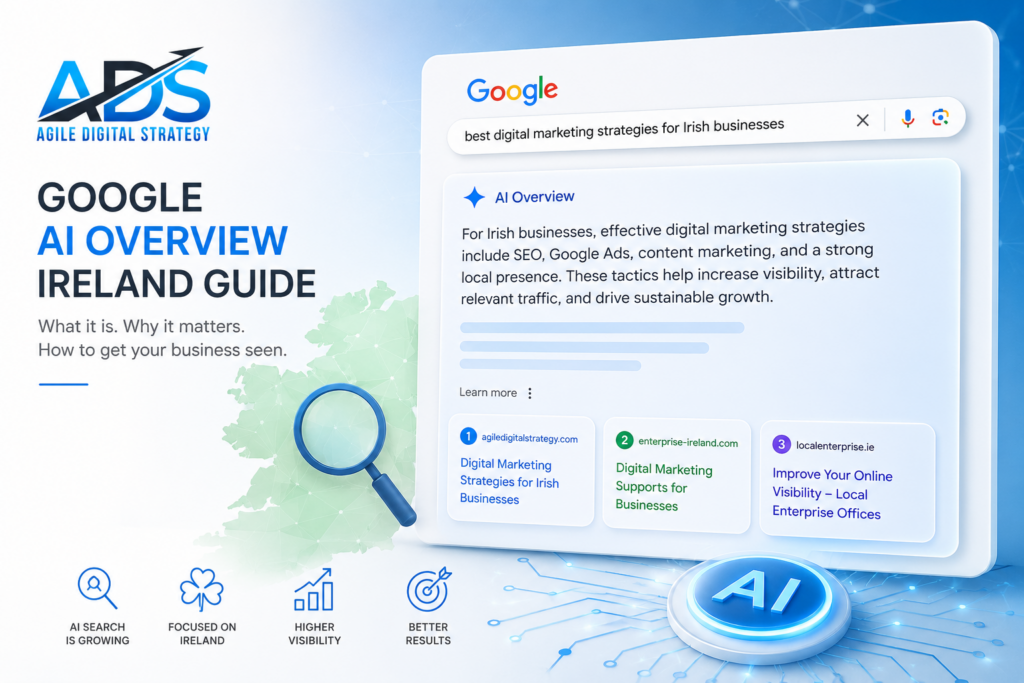
A Google AI Overview is an AI-generated summary that appears at the top of Google search results, above the traditional list of website links, answering the searcher’s question directly and citing a small number of source websites. AI Overviews now appear on roughly 40–48% of Google searches. To get your business cited, your page needs to already rank reasonably well, answer the question clearly in the first 40–60 words, use clean heading structure, and demonstrate real expertise and trust — not just keyword optimisation. |
If you’ve searched something on Google recently and noticed an AI-written summary sitting above the usual list of blue links, you’ve seen an AI Overview. And if you’re a business owner, you’ve probably had the same thought I had the first time I really paid attention to one: “Is anyone even clicking through to websites anymore?”
It’s a fair worry. But the more useful question — and the one this post answers — is how you get your business to be one of the sources that AI Overview cites, rather than one of the ones it quietly leaves out.
What Exactly Is a Google AI Overview?
An AI Overview is a short, AI-generated answer that Google displays at the top of the search results page for certain searches. Instead of showing ten blue links and letting you click through to find the answer yourself, Google’s AI reads across multiple sources, synthesises an answer, and presents it directly — usually citing two or three source websites alongside it.
They run on Google’s Gemini model and, as of 2026, appear on a substantial share of tracked searches — current estimates put this at roughly 40 to 48% of searches, depending on the query type. Alongside AI Overviews, Google has also rolled out AI Mode, a more conversational search experience that lets users ask follow-up questions in a genuine back-and-forth, similar to using ChatGPT directly inside Google Search.
Why This Matters for Your Business
When an AI Overview appears above the search results, a noticeably smaller percentage of searchers scroll down and click through to individual websites — because Google has already answered their question. This is a real shift in how visibility works.
But here’s the important nuance: businesses whose content is cited inside the AI Overview still receive meaningful traffic — often a disproportionate share of whatever clicks remain. The businesses being hurt most by this shift aren’t the ones being cited. They’re the ones being left out entirely.
The strategic question for 2026 isn’t “am I ranking first?” anymore. It’s “am I the source being cited?” And those are increasingly two different questions.
The Surprising Truth: Ranking First Doesn't Guarantee a Citation
This is the part most business owners don’t expect. Recent industry data shows that only around 38% of AI Overview citations come from pages ranking in the traditional top 10 for that same search — down sharply from roughly 76% just seven months earlier. Even more striking: only about 12% of pages ranking in position one actually get cited in the AI Overview for that search.
This happens because of a process called query fan-out. Rather than just reading the top-ranking page for your exact search, Google’s AI breaks your query down into several related sub-questions, searches each of those separately, and pulls together the most useful, clearly-written answers from across all of those results — not just the page that happens to rank first for your original phrase.
In practical terms, this is good news for smaller Irish businesses. You don’t need to out-rank a national competitor to get cited. You need to be the clearest, most trustworthy, most extractable answer to the specific question being asked.
What Actually Gets a Page Cited: The Evidence
Multiple 2026 studies analysing thousands of AI Overview citations point to a consistent set of factors. Here’s what actually moves the needle:
1. A Direct Answer in the First 40–60 Words
AI Overviews extract short, self-contained passages almost verbatim. If your page opens with a long, scene-setting introduction before it actually answers the question, the AI has nothing clean to extract. Every page — and ideally every major section — should open with a tight, direct answer to the question that heading or page is about.
2. Clear, Confident Language
Content written in clear, definitive language is cited nearly twice as often as content full of hedging and qualifiers. This doesn’t mean overstating what you know — it means stating what you do know plainly and confidently, rather than burying it in “it depends” and “in some cases.”
3. Comprehensive Topic Coverage
Blog-style content that covers a topic thoroughly — not thin, 300-word posts — makes up the largest share of AI Overview citations. Google favours pages that answer the full breadth of a question, including the follow-up questions a searcher is likely to have.
4. Clean Heading Structure
Headings written as questions, with a direct answer immediately underneath, are far easier for AI systems to extract accurately. This is exactly why every section in this article — and every well-structured page — should use a proper H2/H3 hierarchy rather than bold text pretending to be a heading.
5. Real Evidence and Statistics
Content that includes specific statistics and named sources sees a meaningfully higher AI visibility rate than content making unsupported claims. Cite recognised sources, name them directly, and back up your claims with real numbers wherever you can.
6. Schema Markup
FAQPage, Article, and HowTo schema markup help AI systems understand exactly what your content is and how it’s structured — giving you a technical, unambiguous signal on top of good writing.
7. Third-Party Validation
Brands are significantly more likely to be cited through third-party sources — press coverage, reviews, industry directories, forums — than through their own website content alone. This means digital PR and earning genuine mentions elsewhere is now part of AI search strategy, not a separate activity.
How This Applies to ChatGPT, Perplexity, and Claude
It’s worth knowing that AI Overviews are only one part of the picture. ChatGPT, Gemini, Claude, and Perplexity each pull from different underlying indexes — ChatGPT largely draws on Bing’s index, Claude has used Brave’s, and Google’s AI Overviews run on Google’s own index. This means the same question can surface completely different sources depending on which AI tool someone is using.
The good news is that the underlying principles are largely universal: lead with a clear answer, structure content for extraction, build genuine topical authority, and earn mentions on trusted third-party sites. Get those fundamentals right and you improve your chances across every AI search engine, not just Google’s.
A Practical Starting Checklist
- ✅ Does every page open with a direct answer in the first 40–60 words?
- ✅ Are your headings written as questions, with the answer immediately below?
- ✅ Have you added FAQPage or Article schema markup to your key pages?
- ✅ Does your content cover the topic comprehensively, not just the surface level?
- ✅ Are you using specific statistics and named sources rather than vague claims?
- ✅ Are you earning mentions on other trusted Irish websites — press, directories, industry sites?
Frequently Asked Questions - Google AI Overviews
Do I need to pay Google to appear in an AI Overview?
No. There is no paid placement or submission process for AI Overviews. Citations are earned through the same underlying ranking and content quality signals that govern normal Google Search — applied through an AI-specific lens.
Will AI Overviews eventually replace normal search results entirely?
Not for every search. AI Overviews tend to appear for informational, question-based searches rather than highly commercial or navigational ones. Traditional search results and paid ads remain highly relevant, particularly for local and transactional searches.
How do I know if my business is being cited in AI Overviews?
Search your key industry questions directly on Google and note whether an AI Overview appears, and if so, which sources it cites. There are also emerging tools designed specifically to track AI Overview visibility over time, similar to traditional rank tracking.
Is this the same as “AI SEO” or “GEO”?
Yes — Generative Engine Optimisation (GEO) is the term increasingly used for the practice of optimising content specifically for AI-generated answers, as distinct from traditional SEO. In practice, the two overlap heavily, and a strong SEO foundation is a prerequisite for GEO success, not a replacement for it.
Want to Know Where You Currently Stand?
Most Irish businesses have no idea whether they’re currently visible — or invisible — in AI-generated search results. Our AI Growth Audit assesses exactly that: how your website and brand currently perform across Google AI Overviews, ChatGPT, Claude, and Perplexity, with a clear, prioritised plan to improve it.
📞 Book a free discovery call – No obligation meeting with Niamh. |
→ · AI Growth Audit · SEO Services |