
Before I walked into the AI and Brand Authority session at BrightonSEO this May, I expected a fairly standard conversation about backlinks, domain authority, and AI Overviews. What I got was something more useful and more challenging: an honest assessment of what we actually know, what we don’t, and what brand authority genuinely means in a world where AI systems are increasingly the first stop in a buyer’s research journey.
The session opened by naming something the industry often dances around: there is real confusion and misinformation in the AI search space, amplified by AI companies with significant financial incentives to promote AI as transformative. That pressure creates a situation where brands and agencies feel compelled to adopt AI search strategies without a clear understanding of what success looks like or how to measure it.
The Measurement Problem Nobody Wants to Admit
One of the most important points of the session was the frank acknowledgement that there is currently no standardised measurement framework for AI search. Many brands are investing in AI search strategies and tools, but there’s little consensus on what success looks like. The tools available — including Search Console and LLM monitoring platforms — rely on APIs that often don’t reflect real user behaviour. They provide partial insights. They don’t capture the full picture of how AI is influencing buyer journeys.
This was uncomfortable to hear but important. I came home from Brighton more confident than ever that honest, transparency-led reporting is the right approach — presenting measurements with stated confidence levels rather than pretending attribution is clean when it isn’t. That’s not a weakness in the reporting. It’s the only intellectually honest way to work with the data currently available.
Authority Redefined: The Ability to Change User Behaviour
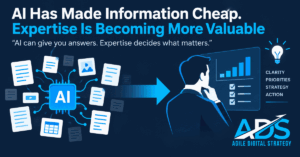
The most significant reframe from the session was this: authority, in the context of AI search, is not about accumulating backlinks or domain authority scores. It is the ability to change user behaviour.
An AI system deciding whether to cite or recommend your business is not running a PageRank calculation. It is synthesising evidence from multiple sources and making a judgment about whether your brand can be trusted to answer the user’s question accurately and completely. The question it is implicitly asking is: does this brand’s expertise and positioning hold up across multiple independent sources, or does it only live on the brand’s own website?
For a business whose digital footprint is primarily its own website, the answer to that question is structurally weak — regardless of how well the website is optimised. One source, however well-written, is an uncorroborated assertion. Multiple independent sources making consistent claims about what your business does and who it serves is evidence.
Moving Beyond Operational Theatre
The session concluded with a phrase that I’ve been returning to since: operational theatre. The superficial adoption of AI for the sake of appearances — using AI tools because it looks like you’re doing AI — rather than pursuing genuine transformation.
The alternative is harder but more valuable: developing a clear measurement strategy, mapping your authority within your competitive landscape, ensuring your brand presence is technically accessible to AI crawlers (JavaScript rendering was specifically flagged as a common barrier), and maintaining consistency across every digital touchpoint.
Technical accessibility matters more than many businesses realise. If AI crawlers struggle to render your website correctly, the content you’ve invested in may simply not be accessible to the systems that your buyers are increasingly using to research suppliers. Semantic HTML, clear content structure, and server-side rendering are not just traditional SEO practices — they are now directly relevant to AI search visibility.
What This Means for Irish Exporters
For an Irish business trying to establish credibility with buyers in the UK or EU, this reframe is particularly important. Your domestic competitors have a head start — AI systems have encountered them in trade publications, industry events, case studies, community discussions, and review platforms. Your business may be encountered primarily through its own website.
Building the evidence base that closes that gap is a structured, medium-term programme. It includes:
- Active presence in industry directories and associations your UK and EU buyers use — not just listed, but contributing
- Verified reviews across the platforms relevant to your sector — each review is an independent corroborating source
- Case studies and outcome-focused content that third-party publications can reference and cite
- Consistent positioning across your website, LinkedIn, Chamber of Commerce listings, and any trade body profiles — inconsistency between sources is a structural weakness AI systems register
- Technical accessibility — ensuring your site renders correctly for AI crawlers, not just human visitors
The session’s call to action was clear: don’t optimise for AI hype cycles. Optimise for genuine expertise, genuine credibility, and genuine consistency. The brands that will win in AI search are the ones that create real value for users and build digital presence that reflects that value across multiple independent sources.