
Most conversations about AI and search focus on one question: does your business appear?
That matters. But there is a second question that is becoming equally important, and most businesses have not started asking it yet.
Does your business get recommended?
There is a meaningful difference between a business that shows up somewhere in an AI answer and a business that is cited as a trusted source, named as a relevant provider, or held up as an example of good practice. The first is passive presence. The second is digital authority.
This article is about building the second kind — and why it is becoming one of the most commercially significant things an Irish business can invest in right now.
From Being Found to Being Trusted
Search has always been about visibility. But the nature of that visibility is changing.
In traditional search, the buyer does the filtering. Google returns ten results. The buyer clicks, compares, judges.
In AI search, the tool does part of that filtering first. Instead of a list, the buyer gets a recommendation. Instead of ten options, they might get three. Instead of a set of links to evaluate, they get a summary that already implies credibility.
That shift — from “here are some options” to “here is who I suggest/recommend” — changes the commercial stakes considerably.
A business that is recommended in an AI answer is not just visible. It has, in a small but meaningful way, been endorsed. The buyer arrives at your website having already been told you are relevant. That is a different kind of first impression.
This is what AI citations are building towards: a form of digital referral that operates at scale, around the clock, across every buyer who uses an AI tool to research a purchase decision.
What AI Citations Actually Are
AI citations are any instance in which an AI tool uses your business as a source to support its answer. That source might be:
- A page on your website
- A case study or blog post
- A service or product page
- A Google Business Profile
- A directory or trade association listing
- A review platform entry
- A news article or media mention
- A partner or supplier page
- A LinkedIn profile or professional mention
Some tools, such as Perplexity, display citations prominently alongside every answer. Google AI Overviews can link to supporting sources. ChatGPT with search enabled can reference pages directly. Gemini, Copilot and Claude may draw on these sources without always showing explicit links — but they are using your digital footprint to form their understanding of your business regardless.
That is the key point. Whether or not a link is displayed, AI tools are continuously building a picture of your business from everything available online. The question is whether that picture is complete, consistent and credible enough to earn you a place in the answer.
Why This Is Different From a Google Ranking
A traditional search ranking points to a webpage. AI citations can influence a recommendation. That is a more commercially powerful position.
Traditional search queries tend to be keyword-driven:
- “SEO agency Clare”
- “septic tank emptying Limerick”
- “industrial yarn supplier UK”
AI queries tend to be conversational and intent-driven:
- “Who would you recommend for SEO in Clare?”
- “What company provides septic tank emptying near Limerick and has good reviews?”
- “Which Irish suppliers provide technical yarns for UK manufacturers and have experience with compliance requirements?”
The AI tool is not matching keywords to pages. It is trying to identify the most credible, relevant answer to a question that involves commercial trust.
To do that, it is looking at what your business claims to do, what third-party sources say about you, whether your information is consistent, what proof exists, and whether your content actually answers the kind of questions buyers ask.
This means the goal is no longer just to rank a page. It is to build a business that AI tools can confidently recommend.
The Hidden Commercial Risk
Here is the part that tends to focus minds quickly.
When a potential customer uses an AI tool to research suppliers in your sector and your competitors are recommended and you are not, you lose that enquiry before you ever knew it existed. No notification. No analytics entry. No data trail.
AI search does not always drive traffic to your website in the way Google does. A buyer may read an AI recommendation, choose a shortlist, and never visit the websites that did not make it. Your Google Analytics will show nothing unusual. Your enquiry volume may simply drift downward in a way that looks like a slow market rather than a structural visibility gap.
This is especially true in sectors where buyers research extensively before making contact — professional services, environmental and industrial services, manufacturing supply, hospitality, financial services, construction and trades. In these sectors, a buyer who is comparing three suppliers might use an AI tool to generate that initial shortlist. If your business has not given AI tools enough clear, credible, consistent information to work with, you will not make the list.
If you want to know whether your business is being cited in AI results right now, the first step is an AI Growth Audit.
→ Find out where you stand → AI Growth Audit
What Builds AI Citations Visibility
There is no single trick that guarantees you will be cited. AI tools are assembling a view of your business from multiple signals simultaneously. The businesses that appear most consistently have not done one clever thing — they have built a stronger overall digital presence.
Here is what that looks like in practice.
1. Clarity About What You Do and Where You Do It
Many business websites are written for an audience that already knows the company. The homepage describes values and passion. The service pages list categories without detail. The About page is brief and generic.
AI tools cannot recommend what they cannot clearly understand. Every page on your website that matters — homepage, service pages, About, case studies — should make it immediately clear what you do, who you serve, where you operate and why someone should trust you.
Compare these two descriptions:
Vague: “We deliver quality solutions for clients across Ireland.”
Clear: “CES Environmental Services provides septic tank emptying, drain cleaning, CCTV drain surveys, grease trap cleaning and industrial tank cleaning across Clare, Limerick and Galway.”
The second version is what gets cited. It is specific, verifiable and directly useful to someone asking which environmental services company to use in the west of Ireland.
2. Service Pages That Answer Buyer Questions
Most service pages end with “Contact us for a quote.” That is a reasonable call to action but an insufficient piece of content for an AI tool to draw on.
AI tools are used most often when buyers are in the research phase — before they are ready to enquire, when they are trying to understand their options. Your service pages need to answer the questions buyers ask at this stage:
- How does this service work?
- When does a customer typically need it?
- What affects the cost?
- What qualifications or equipment are involved?
- What should the customer prepare?
- What mistakes do buyers make when choosing a provider?
- What compliance or regulatory factors apply?
A service page that answers these questions gives AI tools a substantive source to draw on. A thin page gives them almost nothing to work with.
3. Content Written to Be Cited, Not Just Read
There is a distinction between content that is readable and content that is citable. Readable content is engaging. Citable content is structured so that a specific, useful answer can be extracted from it.
Citable content typically has a clear heading, a direct answer, specific detail and no unnecessary padding. Instead of:
“There are many factors to consider when choosing a provider in this space, and the decision can be complex…”
Write:
“When choosing an environmental services provider, confirm they are licensed, insured, experienced with both domestic and commercial waste, and able to provide disposal documentation where required.”
FAQs, cost guides, comparison sections, buyer checklists and process explanations are particularly effective because they mirror the structure of the questions AI tools are trying to answer.
4. Consistency Across Every Online Presence
AI tools build their understanding of your business from multiple sources simultaneously. If the information they find is inconsistent — your website says one thing, your Google Business Profile says another, your LinkedIn description is outdated, your directory listings mention services you no longer offer — that inconsistency creates confusion.
Confusion does not get cited.
Audit your business information across every platform where it appears. Your name, service descriptions, locations, team details and key claims should tell a consistent story everywhere.
5. Third-Party Proof That Corroborates Your Claims
Any business can say it is excellent. AI tools know this. They weight external signals more heavily because they are less likely to be biased.
Third-party proof that contributes to AI citations authority includes:
- Detailed, location-specific reviews on Google and relevant platforms
- Industry body memberships and certifications
- Awards and commendations
- Trade publication mentions and editorial coverage
- Partner and supplier page references
- LinkedIn recommendations and professional associations
- Event participation and speaking credits
Most Irish SMEs have more of this credibility than they realise. The problem is that it is buried — in a PDF on an old page, a caption on a social post, a forgotten press release. If it is not visible, crawlable and connected to your main web presence, it is not doing any commercial work.
6. Case Studies That Combine Service, Sector, Location and Proof
A well-constructed case study is one of the most powerful assets for AI citations visibility because it brings together everything an AI tool is looking for in a single piece of content: service type, client sector, geographic relevance, problem, approach, and result.
This is something we have seen directly in client work.
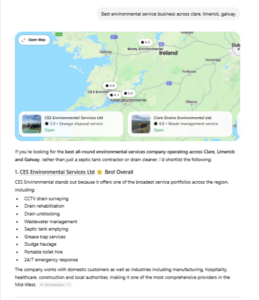
When we partnered with CES Environmental Services — a Clare-based company providing septic tank emptying, drain cleaning, grease trap cleaning and related services across Clare, Limerick and Galway — the objective was to build a stronger, more credible and more consistent digital presence that would earn them visibility in both traditional search and AI-generated answers.
The work involved strengthening service pages with specific, location-relevant content, creating structured content that answered the questions environmental services buyers actually ask, improving local AI citations consistency, and building a case study that clearly demonstrated the scope and quality of the work CES does.
The result was that CES moved from limited AI visibility to being actively recommended across multiple AI tools — including ChatGPT, Google AI Overviews, Perplexity and Gemini — for relevant service and location queries. When a business in Limerick asks an AI tool who provides commercial tank cleaning in the region, CES now appears with supporting proof. When someone in Clare asks which environmental services company is trusted locally, CES is in the answer.
That outcome did not come from one tactic. It came from building a digital presence that AI tools could clearly understand and confidently recommend.
→ Read the full CES Environmental Services case study →
7. Reviews That Serve Two Audiences
Reviews have always influenced buyer decisions. They are now also a significant signal in how AI tools assess the credibility and relevance of your business.
The quality of review content matters as much as the volume. A review that says “great service” confirms little. A review that says “CES arrived on time in Limerick, emptied the septic tank professionally, explained the process clearly and provided full disposal documentation” confirms the service, the location, the process and the outcome. That specificity is useful both to buyers and to the AI systems that draw on review data.
Encourage your customers to leave reviews that describe the actual service they received. Respond to reviews consistently. Make sure your review profiles are active and current across the platforms that matter for your sector.
8. Fresh and Accurate Information
AI tools and search systems favour sources that are current and actively maintained. A website that has not been updated in two years, a Google Business Profile with no recent posts, a blog that stopped in 2021 and case studies that are three years old all signal to AI tools that the information may be outdated.
This matters beyond just freshness. If your business has changed — different services, new locations, updated processes, a shifted focus — and your content has not kept pace, AI tools may describe your business inaccurately. That inaccuracy is invisible to you but visible to every potential buyer who asks about your sector.
Review your key service pages and factual content regularly. Update case studies to reflect current work. Remove or revise pages that no longer represent what you actually do.
How AI Visibility Should Be Tested
One of the most common mistakes businesses make is testing their AI visibility by typing their own name into ChatGPT. That is a useful starting point, but it tests only brand awareness, not commercial discoverability.
Most new customers do not begin with your business name. They begin with a problem. A properly structured AI visibility assessment tests across multiple query types that reflect real buyer behaviour.
Brand Prompts
These test whether AI tools understand your business correctly when your name is used.
Example: “Tell me about Agile Digital Strategy. What do they specialise in and who do they work with?”
Category Prompts
These test whether you appear when a buyer does not already know you — the commercially critical scenario.
Example: “Who provides SEO and AI search visibility services for Irish businesses?”
Location Prompts
These test local and regional discoverability.
Example: “Who provides environmental services in Clare and Limerick?”
Comparison Prompts
These test how AI tools position your business relative to competitors.
Example: “Compare the main SEO agencies in Ireland for SME clients.”
Problem-Led Prompts
These test whether your content is being used to answer the questions buyers ask when researching.
Example: “How can an Irish SME improve its visibility in ChatGPT and Google AI Overviews?”
Proof-Led Prompts
These test whether your case studies and results are surfacing.
Example: “Which Irish digital agencies have demonstrable results in AI search visibility?”
This kind of structured testing should be run across multiple tools — ChatGPT, Perplexity, Google AI Overviews, Gemini and Copilot — because each behaves differently and draws on different data. A business may appear in one tool and not another, or for branded queries but not category queries.
→ Book a structured AI visibility review → AI Growth Audit
How SEO, AEO and GEO Work Together
These three terms are often used interchangeably, which causes confusion. Here is the plain-English version.
SEO — Search Engine Optimisation gets your website found in traditional search results. It covers technical optimisation, content quality, backlinks, local SEO and page structure. It remains the foundation of any visibility strategy.
AEO — Answer Engine Optimisation helps your content answer specific questions clearly. It focuses on FAQs, direct structured answers and question-led content that serves buyers in the research phase of their decision.
GEO — Generative Engine Optimisation focuses on how AI tools understand, cite and recommend your business in generated answers. It goes beyond your website to consider your full digital footprint — reviews, third-party mentions, entity consistency, content depth, case studies and authority signals.
SEO gets you found. AEO helps you answer. GEO helps you get recommended.
A modern visibility strategy requires all three working in coordination, not as separate projects. At Agile Digital Strategy, we build strategies that treat these as connected parts of a single commercial objective: making your business the most credible, most citable, most recommended answer to the questions your buyers are asking.
→ Explore our SEO, AEO and GEO services →
What to Build Right Now
If you want to start improving your AI citations visibility today, here is where to focus.
Strong Core Service Pages
Every important service should have its own dedicated page — not a paragraph hidden on the homepage. Each page should clearly describe what the service is, who it is for, where it is available, how it works and what proof exists that you deliver it well.
Comparison and Decision-Stage Content
AI tools are frequently used when buyers are comparing options. Content such as buyer guides, “what to look for” articles, cost explanations, common mistake summaries and sector-specific advice positions your business as a knowledgeable source at the moment buyers are forming their shortlist.
Specific Case Studies
Include the client type, the challenge, the work carried out and the results. Avoid vague claims. Show evidence. The more specific your case study content, the more AI tools can use it as a credible source.
A Substantive About Page
Your About page should explain what the business specialises in, who you work with, what experience you bring, where you operate and why customers trust you. If you are a founder-led business, your expertise and track record are significant trust signals — they deserve more than a paragraph.
FAQ Sections on Key Pages
FAQs directly mirror the format of AI tool answers. Clear, specific, jargon-free answers to the questions buyers actually ask are among the highest-impact additions you can make to any service page.
Digital Consistency Audit
Check that your business name, service descriptions, locations, team details and key claims are consistent across your website, Google Business Profile, LinkedIn, directories and any other online presence. Inconsistency is one of the most common and most avoidable causes of AI citations failure.
Content Refresh and Rationalisation
If your business has changed direction, your content needs to reflect where you are going. Old pages describing services you no longer offer, outdated team information or case studies from a different phase of the business can actively confuse both buyers and AI tools.
What Not to Do
Since poor advice on this topic is common, here are the things worth saying plainly.
- Do not publish large volumes of AI-generated content expecting it to build AI citations authority. Volume without quality and specificity does not work.
- Do not assume that ranking well in Google means AI tools will automatically recommend you. They are different systems with different criteria.
- Do not treat AI visibility as a one-off project. AI tools update their understanding continuously, and your digital presence needs active maintenance.
- Do not test only one AI tool. Different platforms behave differently. A complete picture requires testing across ChatGPT, Perplexity, Google AI Overviews, Gemini and Copilot.
- Do not rely on schema markup alone. Structured data helps, but it cannot compensate for weak page content or an inconsistent digital footprint.
- Do not create fake reviews or fabricated third-party mentions. These are increasingly detectable and the reputational risk is significant.
How to Measure AI Citations Visibility
Measurement in this area is still developing, but a practical framework is available now.
Track which AI tools mention your business, which prompts trigger a mention, whether you are recommended or only described, which sources are cited, how competitors appear by comparison, and whether the information presented about your business is accurate.
Layer this with wider indicators: branded search growth in Google Search Console, direct enquiry volumes, assisted conversions, Google Business Profile activity and referral source patterns.
And keep asking new leads the simplest question: how did you hear about us?
Sometimes the most important data comes from a conversation, not a dashboard.
The Businesses That Will Be Recommended Are the Easiest to Trust
AI search is not finished developing. Tools are constantly improving. Results will change. Measurement will get more precise.
But the direction is clear.
Buyers want faster answers. AI tools are becoming part of how they research and shortlist. Search is moving from lists of links to summarised recommendations. And in that environment, trust signals matter more than they ever have.
The businesses that earn AI citations will not necessarily be the biggest or the loudest. They will be the clearest about what they do. The most specific in their content. The most consistent across their digital presence. The best supported by external proof.
That is available to any business willing to build it properly. And building it properly is exactly what we do at Agile Digital Strategy.
How Agile Digital Strategy Can Help
We help Irish businesses improve visibility across Google and AI-powered search — not as separate activities, but as a coordinated strategy built around the commercial outcomes that matter.
Our services include:
- SEO strategy and implementation
- AI search visibility (GEO and AEO)
- Service page and content optimisation
- Technical SEO
- Local SEO and Google Business Profile optimisation
- Case study development
- Competitor and visibility analysis
- Google Ads (PPC)
- Digital marketing strategy
→ Start with an AI Growth Audit — find out exactly where you stand →
→ Explore SEO, AEO and GEO services →
→ Read the CES Environmental Services case study →
→ Get in touch with Agile Digital Strategy →
Frequently Asked Questions
What is the difference between AI search visibility and SEO?
SEO focuses on visibility in traditional search results through page rankings. AI search visibility goes further, covering how AI tools understand, interpret and recommend your business in generated answers. The two are related but not the same — a business can rank well in Google and still be largely absent from AI citations.
What are AI citations?
AI citations are the sources AI tools draw on when generating answers. These can include your website pages, blog posts, case studies, reviews, Google Business Profile, directory listings, news mentions and other online sources. When an AI tool cites your business, it increases the likelihood that a potential customer will encounter your brand and receive a positive signal about your credibility during their research.
Why do AI citations matter commercially?
If a buyer asks an AI tool to recommend suppliers in your sector and your competitors are cited and you are not, you lose that enquiry before you ever knew it existed. There is no notification and no data trail, which is why AI visibility gaps are easy to underestimate until enquiries begin to slow without a clear explanation.
What is the difference between AEO and GEO?
AEO (Answer Engine Optimisation) focuses on structuring your content to clearly answer specific questions — FAQs, direct answers, structured sections. GEO (Generative Engine Optimisation) focuses on the wider signals that help AI tools recommend your business confidently: authority, consistency, case studies, reviews, third-party mentions and entity clarity. Both contribute to AI citations visibility.
How long does it take to build AI citations visibility?
Improvements can begin to show within weeks of implementing structured content and consistency changes. Building genuine authority — the kind that earns consistent recommendations across multiple AI tools and query types — typically takes three to six months of coordinated work. The earlier a business starts, the more durable the advantage.
Can Agile Digital Strategy help with AI search visibility?
Yes. We provide SEO, AEO, GEO and AI Growth Audits for Irish businesses that want to be found, understood and recommended — across Google, AI Overviews, ChatGPT, Perplexity, Gemini and beyond. Get in touch to find out where you stand →
About the Author
Niamh Hogan is the founder of Agile Digital Strategy, a digital marketing consultancy for Irish businesses and exporters. With over 20 years of commercial experience and a focus on SEO, GEO and AI-powered search visibility, Niamh works with Irish businesses in manufacturing, engineering, environmental services, industrial supply and hospitality to improve their digital presence in Irish, UK and EU markets.