Summary
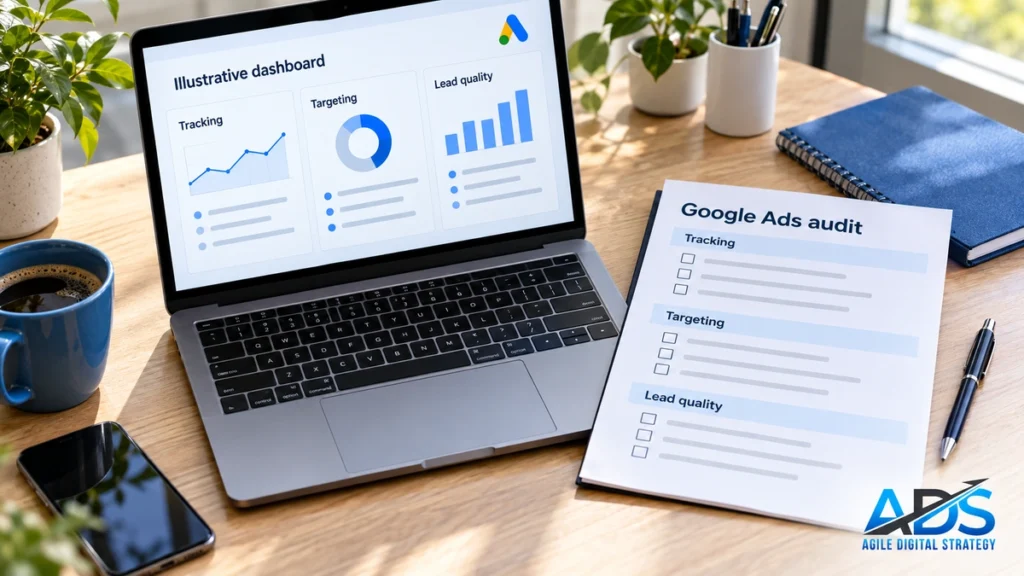
A Google Ads audit should examine conversion tracking, search terms, targeting, campaign structure, bidding, budgets, ads, landing pages and lead quality. Its purpose is to explain where performance is being limited and which improvements deserve priority. A useful audit connects account findings to business outcomes rather than producing a long list of platform warnings.
When advertising is disappointing, the obvious question is often: “Do we need a bigger budget?”
I would ask a different question first: are we making sensible use of the budget already available?
That is where an audit earns its place. Before putting more money into an account, you need to understand what the existing spending is producing.
What is a Google Ads audit?
A Google Ads audit is a structured assessment of an advertising account against the business’s objectives. For a service company, those objectives might be qualified quotations or bookings. For an online retailer, they may be profitable purchases.
The account cannot be judged properly without that context. A campaign attracting homeowners may be unsuitable for a supplier selling only to trade customers, even if the platform reports plenty of conversions.
A good audit starts by establishing what success means, where the business operates, what it can supply and which customers it wants.
Start with measurement
Check what counts as a conversion
List the actions recorded in the account and explain what each means. Identify failed submissions, duplicates, outdated goals and low-value actions presented as leads.
For standard conversion goals, primary actions can influence bidding when their goal is used by the campaign. Secondary actions usually serve observation, although custom goals are an exception.[5] That distinction matters when the account is measuring both enquiries and softer engagement.
Test the customer journey
Complete a form successfully, test an unsuccessful attempt, try the mobile contact options and check that the expected events occur. Do not assume that a tag being installed means the tracking is correct.
Compare advertising data with sales information
The platform may report fifty enquiries. Your team might recognise only twelve worthwhile opportunities. That gap deserves investigation.
Differences can arise through attribution, reporting dates, duplicate events, spam or incomplete sales records. An audit should identify what can be reconciled and what remains uncertain.
Review relevance before reach
Examine search terms and customer intent
Look for spending on services you do not offer, unsuitable locations and searches serving a different audience. Consider buying intent as well as wording: a question about pricing may come from a serious prospect.
Review negative keywords and their conflicts. The goal is to reduce clear mismatches while preserving useful demand.
Inspect targeting and campaign structure
Check whether services, regions and budgets are organised sensibly. A small business does not need dozens of campaigns simply because more structure looks impressive.
Brand, competitor and general service traffic may need separate analysis. Otherwise, inexpensive brand enquiries can disguise weak performance elsewhere.
Review how spending decisions are made
Bidding and budgets
Assess the bidding strategy against the objective, reliability of the conversion data and amount of useful evidence available. Investigate whether targets are unrealistic or spending is distributed poorly across services.
Do not recommend a budget increase solely because the platform suggests one. Establish whether extra demand is commercially worthwhile and whether the business can handle it.
Ads and landing pages
Check that the advertisement and destination page make the same promise. Review service details, location coverage, mobile usability, proof of credibility and the enquiry process.
The audit should identify landing-page issues requiring a developer as well as account settings an Ads manager can change.
Automated campaigns and account access
Where Performance Max or other automated campaigns are used, review the available targeting controls, creative, destinations, reporting and business outcomes. Check product feeds when relevant.
Also review access, billing responsibility and change history. An audit should reveal who can operate the account and whether old users still need access.
What should you receive afterwards?
An audit is only useful if you can act on it. Ask for findings that explain the issue, evidence, likely consequence and recommended response.
| Finding category | Example | Appropriate next step |
|---|---|---|
| Confirmed measurement problem | Form attempt counted as a lead | Repair and retest tracking |
| Clear targeting mismatch | Enquiries for a service not supplied | Review queries, ads and exclusions |
| Improvement hypothesis | Service page may discourage enquiries | Test a specific page change |
| Growth opportunity | Profitable service has limited coverage | Evaluate a controlled budget increase |
Estimated savings should be labelled as estimates. An audit cannot reliably attribute every unconverted click to waste.
Audit first or ongoing management?
An audit suits a business that needs diagnosis, a second opinion or a clearer plan. Ongoing Google Ads management suits a business needing implementation, monitoring and regular optimisation.
You may need both, but they solve different problems. At ADS, the Google Ads Audit service gives you a way to understand the account before deciding on the next step.
FAQs
Can I audit my own account?
Yes. You can review targeting, search terms, conversions and landing pages yourself. Independent expertise becomes valuable when you need to interpret conflicting results, assess tracking or decide which changes should come first.
How much account history is useful?
Enough to reflect the buying cycle, spending pattern and recent changes. A few days rarely tell the full story. Where available, examine recent performance alongside longer trends and comparable seasonal periods.
Is a free automated audit enough?
It can flag issues, but software warnings do not explain your customers, margins or sales process. A human review should interpret the findings and distinguish a genuine problem from a setting that is appropriate for your business.
Do I have to change agency after a Google Ads audit?
No. You can use the findings with your current provider. An independent audit may identify improvements, confirm good management or help you compare future options.