Key Takeaway – AI v’s Expertise |
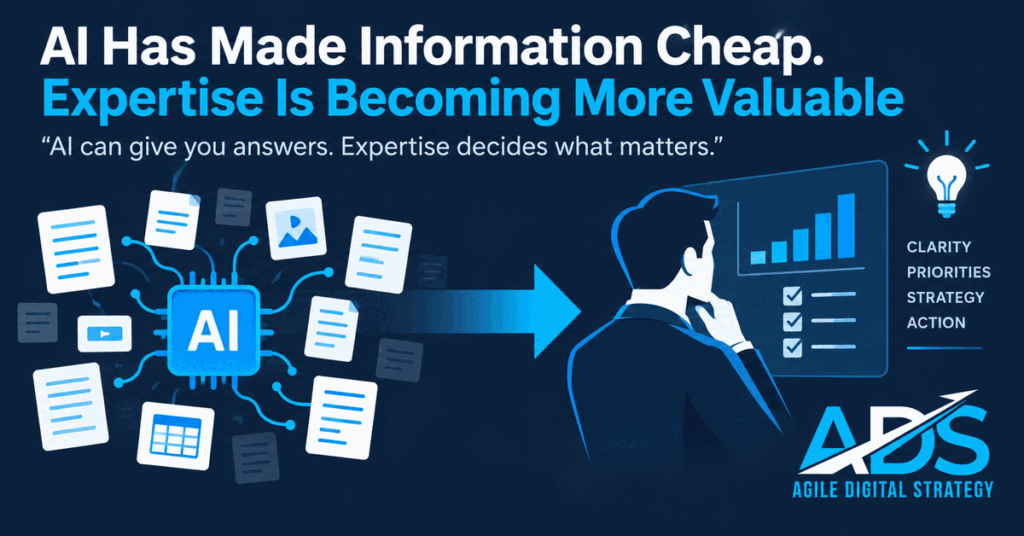
AI has dramatically reduced the cost of accessing information, but information alone doesn’t create business value. As AI becomes universally available, experience, judgement, context and the ability to turn information into action are becoming stronger competitive advantages. |
A few years ago, access to information itself had considerable value. If you wanted to understand why your Google Ads weren’t performing, how your website could rank better, whether you should change CRM system or where automation might improve your business, you generally had three options.
- You could spend hours researching it yourself.
- You could ask someone you knew.
- Or you could pay somebody who knew more about the subject than you did.
AI has fundamentally changed that. Today, you can open ChatGPT, Gemini, Copilot or another AI platform, ask a reasonably good question and get a reasonably good answer within seconds.
- Ask it to explain SEO and it can.
- Ask it for a digital transformation plan and it will produce one.
- Ask for 20 ways to automate a manufacturing business and it will provide.
- Ask it to audit your marketing strategy, recommend software, write advertisements or create a content calendar and you’ll have something on your screen before you’ve finished your coffee.
That is an extraordinary change. But there’s a problem.
Having more answers doesn’t necessarily mean we are making better decisions.
And I think that distinction is going to become increasingly important.
We don’t have an information shortage anymore
Most businesses don’t suffer from a shortage of information. Quite the opposite, we’re drowning in it. There are blog posts, YouTube videos, LinkedIn posts, webinars, podcasts, newsletters, reports, online courses and thousands of new AI-generated articles appearing every day.
Now add generative AI. Instead of spending three hours searching Google and opening ten different websites, you can ask an AI system to digest the subject and explain it to you. That has made information incredibly accessible.
It has also reduced the value of simply knowing something that somebody else doesn’t know.
That presents an interesting challenge for consultants and professional service businesses. Historically, part of our value came from knowledge. Increasingly, clients can access much of that knowledge themselves.
The Medium article that prompted me to think about this makes a similar observation: people can now use AI research tools to become relatively well informed about a topic in a very short period of time and I agree.
But I don’t think that means expertise has become less valuable. I think the opposite is happening.
Information Isn’t the Same as Expertise
AI is exceptionally good at producing information, however, expertise is something different.
Expertise involves understanding the information in context. It means knowing what applies to this particular business, what doesn’t, and why. It means recognising when a technically correct recommendation would be completely impractical. And perhaps most importantly, it means knowing what to do first.
Consider a typical SME. They might ask AI:
“How can I improve my business using AI?”
Within seconds they could receive recommendations involving:
- CRM automation
- AI customer service
- automated quoting
- predictive analytics
- content generation
- email automation
- workflow software
- reporting dashboards
- AI agents
- document processing
- sales automation
- inventory management
All perfectly plausible suggestions. But which one should they actually implement? That’s the difficult bit. Perhaps their biggest problem isn’t AI at all.
- Perhaps staff are entering the same customer information into three different systems.
- Maybe quotations take two days because information has to be manually gathered from different departments.
- Perhaps the CRM they already pay for could solve half their problems, but nobody has configured it properly.
Maybe introducing another system would actually make things worse. Or perhaps there genuinely is an opportunity to use AI that could save twenty hours of administration every week.
The answer depends on the business. That is where expertise becomes valuable.
AI Gives You Options. Expertise Provides Judgement.
One of the biggest benefits of AI is also one of its weaknesses. It can generate an enormous number of possibilities. That is useful during brainstorming. It’s less useful when a business owner needs to make a decision.
Most SMEs don’t need another 40 ideas. They need someone to say:
- These three things matter.
- These seven don’t matter yet.
- Do this one first.
That requires judgement. And judgement tends to come from a mixture of experience, technical understanding, commercial awareness and having seen what happens when businesses make similar decisions.
AI can contribute to that process, it can analyse and it can challenge assumptions. It can find patterns, do research and accelerate thinking. But using AI effectively doesn’t mean handing over every decision to it.
The best results usually come when the technology supports good human judgement rather than attempting to replace it.
The 30-Minute Expert Problem
One of the stranger side effects of generative AI is that it can make all of us feel like experts very quickly. Spend thirty minutes researching a topic with a good AI tool and you can become remarkably well informed, which is useful.
I use AI myself extensively, but there is a difference between being well informed and having spent years working with real businesses, budgets, systems, customers and problems. AI doesn’t remove that distinction, in fact sometimes it makes it easier to forget it.
You can ask AI how Google Ads should be structured. It can explain campaign types, bidding strategies, keywords, conversion tracking and landing pages. But that isn’t the same as looking at an account and recognising that the business is paying for leads it can’t actually service.
You can ask AI how to improve SEO and it will provide an impressive checklist. But a 100-item SEO checklist doesn’t tell an SME which five changes are likely to produce the biggest commercial impact.
You can ask AI which software a business should use and it will compare dozens of platforms. But it doesn’t automatically understand how Mary in accounts, John in operations and the sales team actually work every Tuesday morning. That’s where implementation tends to succeed or fail.
Sometimes the Expert’s Job Is to Say “Don’t Do It”
This may become one of the most valuable roles consultants play in the AI era. AI tends to be very good at suggesting things you could do. Experts also need to identify things you shouldn’t do.
- Not every business needs an AI chatbot.
- Not every manual process should be automated.
- Not every company needs a new CRM.
- Not every website needs 100 AI-generated articles.
- Not every business should chase the newest social media platform.
- Not every Google Ads campaign should use Performance Max.
- And not every shiny new piece of software deserves another monthly subscription.
Sometimes the right recommendation is: Leave it alone.
Sometimes it’s: Fix the process first.
And occasionally it is: You’re solving the wrong problem.
Those answers aren’t especially exciting. They can, however, save businesses an enormous amount of money.
AI Has Made Average Content Extremely Easy to Produce
This change is particularly obvious in marketing. AI can now produce a perfectly acceptable 1,500-word blog article in minutes. That means simply publishing lots of content is no longer much of a competitive advantage. Anyone can do it.
Your competitors can use the same AI tools you use and create the same 50 topic ideas. They can write similar articles and generate similar social posts. Which raises an important question:
Why should Google, an AI search engine or a potential customer choose your business as the source they trust?
Increasingly, I think the answer lies in what can’t easily be replicated.
- Real experience.
- Original research.
- Customer results.
- Case studies.
- First-hand observations.
- Strong opinions backed by evidence.
- Detailed explanations from people who actually do the work.
- Useful data.
- And a recognised business or individual behind the content.
The original medium article makes the point that deep thinking and sustained long-form content can differentiate expertise from shallow AI-assisted output.
That matters enormously for SEO and AI search optimisation.
Your Content Needs to Demonstrate Expertise, Not Just Describe It
For years, businesses have written things like: We are experts in our field. That’s easy to say.
The more important question is: Can somebody looking at your website see evidence of it?
Imagine two businesses offering the same service.
- Business A has: a homepage, service pages and twenty generic articles explaining basic industry terminology.
- Business B has: detailed case studies, original observations, useful guides, customer reviews, named experts, real project examples, industry-specific advice and articles answering difficult questions customers genuinely ask.
Which one feels more credible?
AI search adds another dimension. Platforms such as ChatGPT, Google AI search experiences and other answer engines need information from somewhere.
Businesses therefore need to think beyond traditional keyword rankings. You want your company and its people to become entities that search engines and AI systems can understand, associate with particular topics and – ideally – reference when people ask relevant questions.
That doesn’t come from producing endless volumes of generic AI content. It comes from building genuine authority.
AI Search Is Changing What “Visibility” Means
For many years, SEO was largely discussed in terms of Google rankings. “Where do we rank for this keyword?” That question still matters. But it is no longer the entire picture.
A potential customer might now ask:
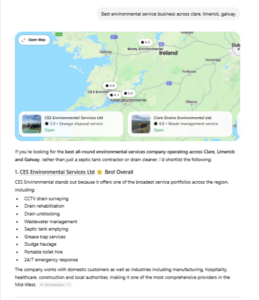
- ChatGPT to recommend providers
- Google an increasingly conversational question
- Gemini to research suppliers
- Microsoft Copilot to compare options
- an AI search tool to summarise an industry
That means businesses increasingly need to think about whether AI systems can: find them, understand them, trust the information about them and associate them with the right subjects.
This is one reason I’ve been increasingly interested in AI search optimisation alongside traditional SEO. It isn’t a replacement for SEO.
In many respects, it reinforces the things good SEO should already have been doing.
- Clear websites.
- Strong expertise.
- Good technical foundations.
- Useful content.
- Case studies.
- Reviews.
- Third-party references.
- Consistent business information.
- Strong entities.
- Original knowledge.
If AI makes generic information plentiful, these differentiators become more valuable, not less.
More Technology Does Not Automatically Mean a Better Business
The same principle applies to digital transformation. Businesses are being bombarded with AI tools. Every week seems to bring another piece of software promising to:
- “10x productivity.”
- “Transform your business.”
- “Replace manual work.”
- Or, my personal favourite, “revolutionise your workflow.”
Sometimes the technology is excellent. But technology isn’t the starting point, the business problem should be. When I look at digital transformation and AI automation, I’m much more interested initially in questions such as:
- How does information move through the company?
- Where is information entered more than once?
- Where are staff waiting for somebody else before they can continue?
- Which processes depend on spreadsheets?
- Where does information get lost?
- Where are customers repeatedly asked for the same information?
- What systems aren’t talking to each other?
- Which software is the company paying for but barely using?
- Where are people spending time on repetitive work that doesn’t require much human judgement?
Those questions generally tell us more than asking:
“Which AI tool should we buy?”
Fix the Process Before You Automate It
Automating a poor process doesn’t necessarily make it better, sometimes it simply helps the business perform a bad process faster. Before automating something, you need to understand why the process exists.
- Can a step be removed altogether?
- Can the process be simplified?
- Could existing software already handle it?
- Does the information need to be captured differently?
Only then should we ask whether automation or AI can improve it. This is one of the principles behind the Digital Transformation & AI Automation work we’re offering at Agile Digital Strategy.
The purpose isn’t to walk into a business carrying a bag full of AI tools. It’s to look at the business itself; its systems, its people, its processes, its information and its bottlenecks. And then identify where technology can make a meaningful difference.
Do Now. Do Next. Consider Later.
One problem with both AI and digital consulting is that businesses can emerge with an enormous list of recommendations. That can be almost as bad as having no plan at all. If somebody gives you 72 things to do, there’s a reasonable chance you’ll do none of them. I prefer a much simpler approach.
Do now
These are improvements that make sense immediately. Perhaps they are relatively inexpensive or they remove a significant bottleneck or they address an obvious risk. Or perhaps they create the foundation required before other improvements can happen.
Do next
These make sense, but they aren’t the first priority. There may be dependencies or may require more planning or the potential benefit simply isn’t as urgent.
Consider later
These are ideas worth keeping. But there is no reason to spend time or money on them today.
That final category is important. Good strategy isn’t only deciding what to do.
It is also deciding what not to do yet.
Experience Becomes More Valuable When Everyone Has the Same Tools
There is another important effect of AI. Businesses increasingly have access to the same technology. Your competitor can use ChatGPT and image generation and so can you.
They have the same access to automation platforms, CRM systems, analytics software and advertising tools.
Technology alone therefore becomes less of a differentiator. The advantage comes from how you use it.
A good carpenter and somebody who bought an expensive toolbox technically have access to many of the same tools. That doesn’t make the results identical.
Digital technology is no different.
AI Can Tell You What Best Practice Is. Real Businesses Rarely Look Like Best Practice.
Consultants deal with something AI sometimes struggles with: reality.
Real organisations are messy.
- The website hasn’t been updated because the employee who understood it left three years ago.
- The CRM contains duplicate records.
- One member of staff insists on using Excel.
- Another keeps everything in email.
- A system can’t be replaced because it integrates with a machine purchased in 2014.
- The directors disagree about priorities.
- Nobody knows exactly how the reporting spreadsheet is generated, but everybody is afraid to touch it.
A purely theoretical answer might recommend replacing everything. The experienced answer may be: Don’t.
Work around the constraint, improve what you can and reduce risk. Get the biggest return for the least disruption.
That may not make for an exciting AI demo. But it’s often what businesses actually need.
Trust Still Matters
AI can accelerate the process of gathering information, but it hasn’t eliminated the importance of trust. In fact, as the amount of generated content increases, trust may become more important.
Business owners ultimately have to decide:
- Who do I believe?
- Who understands my situation?
- Who has done this before?
- Who will tell me when my idea isn’t sensible?
- Who will still be accountable if this doesn’t work?
That last question is particularly important. Software provides outputs, however Advisers make recommendations and stand behind them. There is a difference.
The Medium article also makes an interesting point about relationships and referrals becoming particularly important as people become overwhelmed with cold outreach, sales messages and information. That resonates with me.
People don’t necessarily want more sales pitches. They want people they trust.
Where Does This Leave Consultants?
I think consultants who simply sell information are going to have a harder time. If your entire value proposition is: “I know things you don’t know”, AI is rapidly narrowing that gap. But that isn’t the only thing good consultants provide.
A good adviser helps a business:
- understand the problem properly
- ask better questions
- challenge assumptions
- identify risks
- see opportunities that aren’t obvious
- compare realistic options
- prioritise
- implement
- measure what happened
- change direction when circumstances change
AI can support every one of those activities and that’s exactly how I think it should be used. Not AI versus expertise.
AI combined with expertise.
What Does Expertise Look Like in the AI Era?
Perhaps the definition is changing. Being an expert no longer means being the person in the room who has memorised the most information, as AI will win that competition. Instead, expertise increasingly means being able to take an enormous amount of available information and turn it into something useful. It means knowing:
What’s relevant?
What’s realistic?
What’s commercially sensible?
What’s a distraction?
What’s the risk?
What should happen first?
And what is actually going to make a difference?
That is much harder to automate.
The Opportunity for SMEs
There is also a very positive side to all of this. AI gives smaller businesses access to capabilities that would previously have required much bigger budgets.
- Research that could have taken days can happen in hours.
- Small marketing teams can produce far more.
- Routine administrative work can be reduced.
- Data can be analysed faster.
- Processes can be documented.
- Ideas can be tested.
- Information buried in documents can become accessible.
- Reports can be summarised.
- Customer communications can be improved.
- Small businesses can potentially achieve an enormous amount with relatively modest technology.
But the businesses that benefit most probably won’t be the ones that sign up for the greatest number of AI tools. They’ll be the ones that identify the right problems to solve.
Start With the Business, Not the AI
If you’re looking at AI within your own business, don’t start by asking: “How can we use AI?” Try asking:
“Where are we wasting time?”
“Where are customers experiencing delays?”
“Where is information being entered twice?”
“Which decisions take too long because we don’t have the right information?”
“Which repetitive tasks are taking people away from more valuable work?”
“What does our team constantly complain about?”
Those questions are much more likely to uncover useful opportunities. Then ask whether AI, automation, better software, better integration – or simply a better process – can solve them.
Sometimes AI will be the answer. Sometimes it won’t be – That’s the point.
AI Isn’t Reducing the Need for Expertise. It’s Changing What We Value Expertise For.
We are entering an era where almost anyone can access high-quality information almost instantly, which is a very good thing. Knowledge shouldn’t be artificially difficult to access.
But information was never the same thing as wisdom. And it certainly wasn’t the same thing as implementation.
As information becomes cheaper, I believe the value moves further towards: experience, judgement, context, prioritisation and execution. That’s ultimately where businesses get results.
AI can tell you what is possible. An experienced adviser should help you determine what is worth doing.
And increasingly, I think that distinction is where the real value lies.
“AI can give you information in seconds. Expertise is knowing which information matters, what to ignore, and what to do next.”
— Niamh Hogan, Agile Digital Strategy
Need Help Working Out Where AI Could Actually Improve Your Business?
At Agile Digital Strategy, we help Irish businesses look beyond the AI hype and identify practical opportunities to improve marketing, systems, workflows and business processes.
Our work includes Digital Transformation & AI Automation, SEO and AI Search Optimisation, Google Ads and Digital Strategy.
If your business is considering AI or automation but you’re not sure where to start, the first step isn’t necessarily buying another tool. It’s understanding where the real opportunities are.
Talk to Agile Digital Strategy about a Digital Transformation & AI Automation Review.
FAQ: AI, Expertise and Digital Transformation
Will AI replace business consultants?
AI is likely to change consultancy considerably, particularly where consultants mainly provide research or information. However, businesses still need context, judgement, prioritisation, implementation support and accountability. AI can support those activities, but simply having access to information doesn’t automatically produce the right business decision.
Why is human expertise still important when AI can answer questions?
AI can provide a wide range of possible answers. An experienced professional can assess those answers against the company’s goals, budget, people, systems, risks and commercial realities. The value often lies in determining which recommendation is relevant and what should happen next.
How can SMEs use AI effectively?
Start with a real business problem rather than an AI tool. Identify repetitive work, delays, duplicated data entry, reporting issues, customer-service bottlenecks or inefficient workflows. Then assess whether AI, automation, existing software or process improvements could solve the issue.
What is the difference between AI strategy and digital transformation?
AI strategy focuses specifically on where artificial intelligence could support the organisation. Digital transformation is broader and may include processes, systems, integrations, automation, data management, reporting and changes to how work is completed. AI may form part of a digital transformation programme without being its central component.
Can AI help with SEO?
Yes. AI can support research, content planning, data analysis and various SEO tasks. However, successful SEO still requires technical implementation, strategy, quality content, authority and an understanding of search intent. Businesses also increasingly need to consider how their content and brand appear within AI-powered search and answer platforms.
Should businesses create all their content using AI?
AI can be very useful during research, planning and content production, but publishing large volumes of generic AI-generated content is unlikely to create much differentiation. Businesses should incorporate genuine experience, original insights, case studies, customer knowledge and expert input wherever possible.