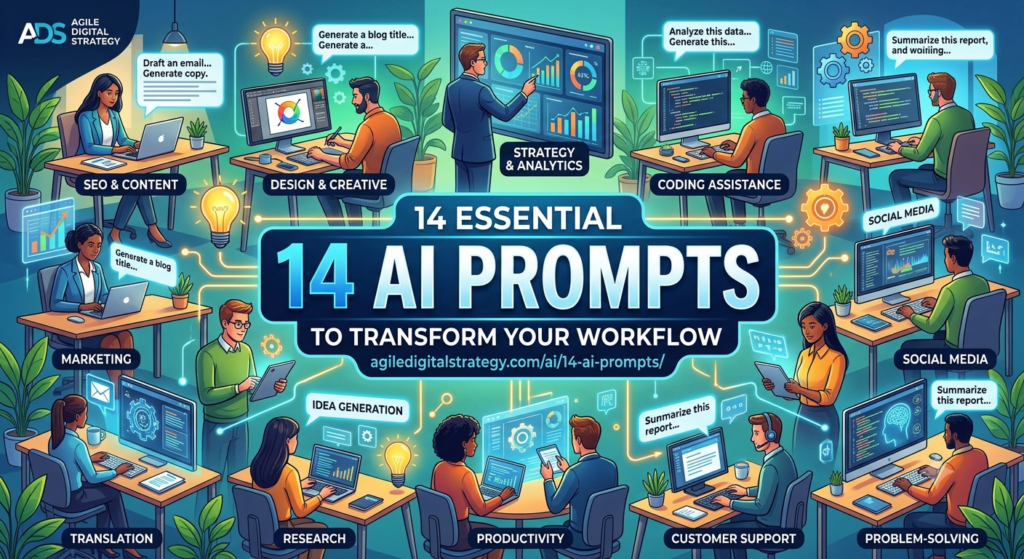

AI Robot helping business lady at her laptop — using AI prompts without sounding like everybody else
One of the biggest misconceptions about AI is that the magic is in the tools ability. We however believe the magic is in the instructions in the AI prompts.
Ask vague questions and you’ll get vague answers. Give clear instructions and suddenly AI starts earning its keep — saving you hours on emails, proposals, social content and the kind of busywork that eats into a working week.
We use a combination of the below prompts every day at Agile Digital Strategy, with clients across Ireland who want practical, no-nonsense ways to get more from AI without becoming “tech people” overnight. Below are fourteen prompts that consistently deliver better results, plus the four ground rules that guide AI to providing a better solution.
It is worth spending an thirty extra seconds writing a better AI prompt question and you’ll get a dramatically better answer.
Before You Start: The Four Golden Rules
Every prompt below builds on these four main foundations. These are some of the same guidelines that you would give your marketing team to help with detail on your product/service.
✅ Tell AI who it should be. “Act as a senior digital marketing consultant…” Giving AI a role narrows its focus and changes its vocabulary, tone and level of detail. A “senior consultant” writes differently to a “junior copywriter” — and AI knows the difference.
✅ Tell AI who your audience is. “Write for Irish SME owners with no technical knowledge.” Without an audience, AI defaults to a generic, corporate voice. With one, it adjusts language, examples and assumed knowledge to match the people actually reading your content.
✅ Tell AI what success looks like. “The goal is to generate enquiries, not simply to explain the topic.” AI will happily write an accurate, informative, completely useless piece of content if you let it. Defining the goal — leads, sales, trust, clarity — keeps the output commercially focused.
✅ Tell AI what to avoid. “Don’t use jargon, clichés or corporate language.” This single instruction does more to fix “AI-sounding” content than almost anything else. Be specific about the words and phrases you’re sick of seeing (enough of “in today’s fast-paced digital landscape”).
1. Improve This Without Changing My Tone
“Rewrite the following text to improve clarity, grammar and flow without changing my writing style, tone or personality. Keep my sentence rhythm and word choices where possible, just tighten and clarify.”
Why it works: Most AI rewrites flatten your voice into generic “AI English.” This prompt explicitly protects your tone, so you get a cleaner version of you, not a replacement for you.
Best for: emails, blog drafts, proposals, LinkedIn posts, website copy.
2. Act as My Ideal Customer
“Act as my ideal customer: [describe them — age, role, problem they’re trying to solve]. Read the following webpage/document and tell me any questions, objections, doubts or points of confusion you’d have after reading it.”
Why it works: You know your business too well to spot the gaps a stranger would notice immediately. This prompt forces AI to read with fresh, sceptical eyes — exactly the eyes your real customers are using.
Best for: finding gaps in website content, sales pages, proposals and pitch decks before you publish or send them.
3. Challenge My Thinking
“Review this business idea/plan/decision and play devil’s advocate. Identify weaknesses, risks, false assumptions and anything I may have overlooked.”
Why it works: Most people around you are too kind (or too busy) to properly stress-test your ideas. AI has no ego invested in agreeing with you, which makes it a surprisingly good sparring partner.
Best for: business plans, pricing decisions, new service launches, strategy reviews.
4. Explain It Like I’m Busy
“Explain [topic] in plain English, as if you were speaking to a busy business owner with no technical background and five minutes to spare. Use one simple analogy and skip anything that isn’t essential.”
Why it works: Jargon-heavy explanations waste time and erode confidence. This prompt forces AI to prioritise clarity and brevity over showing off how much it knows.
Best for: understanding technical subjects (SEO, GDPR, cloud hosting, AI itself) before you explain them to a client, team member or yourself.
5. Create Better Questions
“Based on everything I’ve told you about [topic/business/project], what questions should I be asking that I haven’t considered yet?”
Why it works: This is one of the most underused AI prompts in business. We’re trained to ask AI for answers — but some of the most valuable AI output is a list of the right questions you didn’t know to ask.
Best for: strategic planning, risk assessment, project kick-offs, client discovery calls.
6. Turn This Into Social Media Content
“Convert the following blog post into: three LinkedIn posts (each with a different angle and a clear hook in the first line), four Facebook posts written more casually, and two short-form content ideas suitable for Instagram or TikTok. Keep my brand voice and don’t repeat the same hook twice.”
Why it works: One piece of long-form content can fuel weeks of social media activity if you ask AI to repurpose it properly — rather than simply summarising it once.
Best for: stretching content marketing budgets and maintaining a consistent posting schedule without starting from scratch every time.
7. Analyse This Data
“Review the following anonymised data [paste data] and identify: the three most significant trends, any unusual patterns or outliers, and one or two commercial opportunities I should investigate further. Explain your reasoning in plain English.”
Why it works: AI is genuinely strong at spotting patterns across large data sets quickly — but only if you ask it to interpret, not just describe.
Best for: sales reports, survey results, website analytics, customer feedback, campaign performance data.
(Always remove personally identifiable or commercially sensitive information before sharing data with any AI tool.)
8. Improve My Prompt
“Before answering, review and improve this prompt for clarity and effectiveness. Explain what you changed and why, then answer using the improved version: [your original prompt]”
Why it works: This is the prompt equivalent of asking someone to proofread your email before you send it. It teaches you to write better AI prompts over time — and you get a noticeably better answer immediately.
Best for: anyone who feels like their AI results are “fine but not great.”
9. Create a Customer FAQ
“Using the information below about a “product/service” , create the 20 most common questions a potential customer would ask before buying, along with clear, honest, jargon-free answers. Group them under three headings: Before You Buy, Pricing & Process, and After You Buy.”
Why it works: A strong FAQ section answers objections before they become reasons not to buy — and this prompt does the research and structuring for you in seconds. A strong FAQ section also helps your business get found in AI Seach answers (AEO).
Best for: websites, brochures, sales teams, onboarding documents.
10. Sound More Human
“Rewrite this content so it sounds more natural, conversational and human, as though a real person wrote it in one sitting — while keeping the key message and all facts accurate.”
Why it works: Possibly one of the single most useful AI prompts in this entire article. AI-generated content has a recognisable rhythm; this prompt actively works against it.
Best for: literally everything you plan to publish.
11. Stress-Test My Pricing
“Act as a price-sensitive potential customer comparing me to two or three competitors. Based on the following pricing and service description, tell me what would make you hesitate, what would make you walk away, and what would convince you to pay a premium.”
Why it works: Pricing decisions are often made on gut feeling. AI prompts like this brings an outside, customer-first perspective into the conversation before you commit.
Best for: new service launches, repositioning, package and tier design.
12. Write My Meeting Follow-Up
“Based on these meeting notes [paste notes], write a clear, professional follow-up email summarising what was discussed, agreed actions with owners and deadlines, and a confirmation of next steps. Keep it concise — no more than 200 words.”
Why it works: Follow-up emails are essential but tedious. This prompt turns messy notes into something genuinely client-ready in under a minute.
Best for: client meetings, internal project updates, supplier negotiations.
13. Spot What’s Missing From My Website
“Act as an SEO specialist and a potential customer at the same time. Review the following page content and tell me what’s missing that would help it rank better in search engines, and what’s missing that would help a real visitor trust and convert.”
Why it works: Combining two roles in one prompt gives you a dual-lens review — technical and human — without needing two separate consultants.
Best for: website audits, landing page reviews, content gap analysis.
14. Best AI Prompts Often Start With a Role
The strongest results almost always begin the same way:
“Act as a digital marketing consultant…” “Act as a hotel guest…” “Act as a potential customer…” “Act as an SEO specialist…”
But here’s the part most people miss: the best AI prompts are usually the second prompt. Experienced AI users rarely accept the first answer. We refine, challenge and rephrase the question until the output becomes genuinely useful. That habit — not any secret prompt — is the real difference between average AI users and the people getting exceptional results.
Bonus Question: The One I Use Most
“What would a sceptical customer think after reading this?”
Because the customer doesn’t care how clever your marketing sounds. They care whether it answers their questions or provides what they need. And that’s something both humans and AI occasionally forget.
Niamh’s Quick AI Rules
- Never publish the first draft.
- Remove/reword 30% of the words.
- Add your own examples.
- Fact-check everything.
- Read it out loud.
- If it sounds like a corporate jargon/brochure, start again.
Most AI content isn’t bad because AI wrote it — it’s bad because nobody bothered editing and improving it.
What AI Still Can’t Do
- Build trust
- Understand your customers like you do
- Know your business history
- Attend networking events
- Deal with difficult customers
- Understand local nuances
As yet.
Want Help Putting This Into Practice?
Knowing the best AI prompts is one thing — building AI into your day-to-day marketing, sales and operations is another. At Agile Digital Strategy, we help Irish SMEs grow their business, including use AI practically: not as a gimmick, but as a genuine time-saver that still sounds like you.
Book a free 15-minute AI strategy call and we’ll show you exactly where AI could save your business the most time this month — no jargon, no obligation.
Found this useful? Share it with a colleague who’s still typing “write me a blog post” into ChatGPT and wondering why it sounds nothing like them.